Friday, 30 April 2010

Evaluation - Technologies

How did you use new media technologies in the construction and research, planning and evaluation stages?
1. 5.1 Mega pixel Camera

This is a simple digital camera which can be used to take photos. I used this camera to take photos during filming to contribute towards the blog. If I didn’t have access to this camera I could of used a camera phone.

2. Microphone
This microphone detects every bit of sound. I learnt this the hard way and during the A2 stage of using this equipment I learnt the importance of complete stillness. Also how phones can cause interference ruining a day’s work. If I wanted an alternative I could of used a cheaper microphone or the default sound recorded from the camera.

3. Blogger.com
This is the website which this blog is hosted on. Due to blogger.com I learnt the frustration uploading big files can cause. An alternative to this could be another blogging website.

4. Microsoft Word
I’ve used Word for many years now, so I didn’t learn anything new. An alternative would of been openoffice.org software.

5. PD150
This equipment was entirely new to me. I learnt how to use a PD150 including how to; record, check sound levels, focus, connect to the microphone, set up on the tripod. An alternative to this could of been a cheaper camera like a handheld camera.

6. Internet
Primarly used for secondary research. An alternative to this could be books.

7. Adobe Photoshop CS3
Photoshop has been helpful with the creation of the ancillary task and the ID card featured in the film. Alternatively I could of used paint to create the similar but lower quality products.

8. Adobe Premiere Pro CS3
The usage of Premiere Pro upped this year as there was a lot more film to edit. I learnt the importance of not rewinding the tape after use. I also learnt about editing seamless sound levels. Alternatively I could of used Windows movie maker at the sacrifice of complete control and awesome effects.

9. Tripod
I didn’t learn anything new about the Tripod this year. However, if I didn’t want to use a tripod I could of used a crane if money wasn’t an issue or simply just my hands.

Evaluation - Feedback

What have you learned from your audience feedback?

Feedback on Rough Cut

//ROUGH CUT VIDEO
//ROUGH CUT COMMENTARY VIDEO
Below are my responses to the feedback of the rough cut of our short film.

Callum Baker
I’m glad he got the point of the narration. We wanted it to have strong narration and hint towards a documentary style. I can’t take credit for the camera work so well done to Joe Barden for doing a good job there. The transitions at the end were used to cover up continuity mistakes of the character, Paul, when he walks down the stairs. He leads on the wrong foot in each shot. I understand that it doesn’t look good and slows down the pace of the film and probably contributed towards Callum’s next point that the film is long-winded at times. This scene will need to be re-shot and we need to become more aware of continuity issues.

Chloe Robinson
Well done to myself and Joe Barden for doing a good job with the sound editing. I agree with the point that the introductory shots last to long. This point will be taken into consideration when we re-edit the film and we will probably shorten the introduction. Her point about a few shots going out of frame was done deliberately to connote that the room was small and it was also done to add effect.

Grace Davis
I agree that the role of the mother wasn’t made clear. She is supposed to be a ghost-like figure but this point didn’t come across. We will have to take this into consideration and think if there is a better way to make this point.

I disagree with her point about the set design, although I’m slightly confused about this comment I get the impression that she wasn’t clear on what the set was suppose to be. The general feel of the whole film is that you slowly learn more and not everything is revealed straight away.

Tanya Reynolds
Her first point about the association between the mise-en-scene and white and how this created a chemical and clinical feel was done unintentionally. I love her overuse of the word “perfect”. Her point about the music and how the meaning of the music changes from the start as it is cheery and then at the end it is more “morbid”. This was also done unintentionally.

Emma Horton
That point about the transitions being “good” I disagree with, as mentioned before, the transitions at the end slowed down the pace of the film. However, I do agree with the point about the music. Generally it was positive feedback.

Camilla Braine
I’m glad that the empathy part of the film came across, this was important to keep the audience entertained. I also agree with the point about the walking away shot. It needs to be made clearer what exactly is happening. The music at the beginning will be revised and where it starts and cuts out will be changed.

Danah Hussain
Danah’s point about getting the sound sorted is a valid point, it isn’t equal throughout and we will correct this before the final product. As mentioned before, the pace of the film will be re-evaluated.

Overall
Overall, it’s all positive. A lot of the suggested altercations will be implemented but me and the group are happy with the responses.


Final Film Feedback
//FINAL FILM
Below are some of the comments from people who had seen the film. This audience was a different age group audience of all adults instead of students.

Becky (Knee deep in the media industry) – It was very good. However, I knew the whole time that he was a crime scene cleaner. I didn’t get the impression that he was anything else. One critic is that there is too much of the monologue. Films are a visual media not an auditory.

Geoff Shephard (aka Paul Bison, leading role) – I’m impressed, you can see a lot of hard work has gone into making this film, I should know. Being part of a production like this really gave me an insight into the workings and mechanics of the film industry. Now I understand why it takes so long for films to be made.

Miss Wells (English & media teacher) – It was really good. The running monologue reminded me of the programme talking faces if you’ve ever heard of it. I think it was a BBC programme where they had people talk about themselves in this ongoing monologue much like your film.

Avis (English degree, film studies course and devoted mother) – The overalls looked good; I’m glad all that money didn’t go to waste. I got the sense of the sets and the character being clinical by the use of the colour white. Mr Shephard performed wonderfully and should consider a new career. This maybe unrelated, but in one of your postcards it had “close tightly” on the lid of a bottle. I got the impression that the main character (Paul) was also closed tightly and in this film he let it all out.

Ancillary Texts Feedback
To find out the opinions of my ancillary texts I conducted some research by using questionnaires to find out some quantitative data and will represent them in graphs.

Postcard Question Results
Did you understand that this is a postcard promoting a film? (Yes/No)

I’m happy with this result as the main purpose of the postcard was to show that this is a new film. When questioned further participants released that the postcard was for a film when they saw the back.

Did you like the postcard? (Yes/No) Slightly upsetting as a third didn’t like them. When questioned further those who disliked it didn’t like the blandness of the postcard.

On the basis of the postcard alone, would you go and watch the film? (Yes/No)

This question is crucial as it is the main purpose of the postcard. However, sadly it is a 50/50 split. Perhaps another element was required to get people attending the film which at the end of the day matters.

Review Question Results
Do you think this is from a real Total Film Magazine? (Yes/No)
A full pie, this has made me happy. That means it is authentic enough by the visuals and the written to appear in an Total Film magazine.

Would you be inclined to watch the film after reading this review? (Yes/No) More are willing to watch the film after reading the review, which is great news. When questioned further, some but all said they simply don’t like short films. Sometimes, you can’t please everyone.

Saturday, 17 April 2010

Evaluation - Ancillary

How effective is the combination of your main product and ancillary texts?

Postcards
I had in my mind already the idea of objects related or seen in the film being the background of the postcards, with simple text which doesn’t distract from the background image but simply informs of the name of the film and the actors. I avoided taking a shot of anything which revealed too much of the plot of the film as it would take away the suspense created in the film.
Bucket


The first shot of the movie is of a bucket. I really liked this shot and liked the bucket. I used a high-quality camera to take a picture of the bucket at the scene as found in the film. Although it’s at a different angle and doesn’t have water I think the message get’s across. Another reason why I choose to use the image of the bucket was because it is closely associated to the job of Paul Bison. I didn’t add too much detail with texts and I left it quite simple. I wanted the quality of the image to stand out and for there to be emphasis on the title and main character.
Better-days
In this postcard there is the quote of the film which stood out to me. It’s what Paul says at the end of scene 2. I feel as though this quote captures the whole message of the film. The full quote being “...sometimes if I finish early I get to pick the kids up; those are some of the better days.” This quote encapsulates the message of the film, that in the end it’s all worth it for the kids.
Dettols
When I took this photograph I didn’t expect it to look this good. Due to the quality of the camera, every detail is captured and this enhanced the overall presentation of the postcard. I used three shots of the blue bottle of bleach for the backgrounds of the postcards because they turned out so good. The reason I wanted a picture of bleach was because it featured in the film and Paul himself uses it as a prop as he shakes it and says “...dettol actually...” This is also the reason why in one of the blue bottle bleach postcards it has that quote.
Gloves & Sponge
These gloves feature in two scenes and the sponge features in the introduction. I chose to take the picture of them for the same reasons as I did for the bucket and dettol. They were both props used and seen in the film and hint towards the “job” that the film title is talking about but without giving it away. With the sponge postcard, at first it is hard to tell what it is. This reflects the plot and feel of the film as you it’s hard to tell what Paul’s job is at the first until it is revealed to you.
Only-a-job
This postcard features the beginning scene of the scrubbing and the end quote of “...it’s only a job...” I felt that bringing these two together created a good postcard. This poster hints towards the “job” that the film title is talking about but it doesn’t give it away.

Film review


(this is the written version of my commentray)

Hello, this is my auditory commentary on my review.

I have based my review on film review magazines like Empire and Total Film. In these magazines you’ll find an image attached to each review which is normally a shot from the film or somehow related to the film. They always have a slightly witty comment with them which is related to the image, the film or the actors. For my review I have wrote “More than just a bucket”. This was demonstrating that this film has a lot more to offer.

I have followed the conventions of a film magazine layout. The title is a bigger font than the rest of the article. I have a witty play on words sub heading which says “no scrub” which is referring to the song “No scrubs” by TLC and the other meaning to the word scrubs of beginner. I have below this, key information about the film such as the director, cast, running time and a brief explanation of the plot. The first sentence of the review is in bold which is another convention found in film magazines. I have also ended the review with a “verdict” which sums up the review in a sentence. Underneath that is the 5 star rating where I gave it 4 stars.

I tried my best to match the same style of an Empire or Total Film article. I’ve done this by keeping an upbeat tone to the review. I avoided using the highly intellectual wordplay used in a review such as the Sight and Sound magazine and also avoided using the simple language used in reviews found in magazines like heat. Finding a balance in-between Heat and Sight and Sound is where the review style of Empire and Total Film stands.

I understand that magazines like Empire are for mainstream blockbusting films. However they do feature the smaller films from time to time but give them smaller spaces on the page. So if they ever did do a short film special edition my review would fit in comfortably. Especially if it’s suggests for readers to visit online to view the film. The audience that would purchase a short film edition of Empire is the kind of audience that we want to appeal to.

Friday, 16 April 2010

Review Development

As concluded at the end of the analysis of reviews, I will use the same textual style and visual style as found in an issue of Empire or Total Film.

This is the review page before I make my adjustments:This is the adjusted review page with my review added in:
This is just my review by itself:

As you can see I kept strictly with the conventions of the layout of the film for the bigger review pieces. I matched the different fonts used in the main text and the additional information segments. The colours are exactly the same and so are the effects. However, the style of writing my not appear in a magazine like this as my quality of writing skills simply don’t match up.

This is an earlier attempt of a film review page:


This image didn’t stick with the conventions of the magazine so it had to be changed.

Thursday, 15 April 2010

Analysis of Film Reviews

In this section I have analysed different film reviews to get a grasp on how to write a review for my short film.

Comparasion between Johnny Mad Dog and Twilight
The initial difference between the two reviews that is noticed is the use of adjectives. In The Guardian review the adjectives are less and they are commonly used adjectives such as “lovely”, terrifically” and “youthful”. They also use slang terms to describe for instance “bejeepers”, “manky” and “shag”. However in the Sight and Sound review there are tons of adjectives used and all adjectives used are uncommon such as “nefarious”, “hackneyed” and “voyeuristic”.

Due to the sophisticated word play and the uncommon adjectives seen in the Sight and Sound review it makes it hard to understand in one reading and requires someone of high intellect to understand fully. This is the opposite of The Guardian’s easy-to-pick-up-and-read approach.

A difference between the two reviews is how easy they are to understand. The Guardian you can read through once and get the just of the opinion being expressed. In the Guardian they repeat themselves several times. The point made about Bella being abstinence is repeated several times throughout the review. This makes the review easy to understand as the key points are repeated.

Sight and Sound, is a different story. Sight and Sound doesn’t repeat itself and goes into huge details into all the different factors which make up a film. Sight and Sound discusses the mise-en-scene of the movie, the director’s background, the films background and even the soundtrack.

The Guardian review doesn’t comment on many of those factors but instead it focuses on the characters. It talks about what the three main characters have to go through in the film. The Guardian avoids technical aspects such as mise-en-scene and the only background factors mentioned are the director’s name and actors’ name.

The reasons for the differences in style are due to the differences in audience. The Guardian is focused at the casual mainstream audience. So there differences in vocabulary and ease of reading are necessary. Sight and Sound has a serious film watching audience. Their style of writing reflects the level of sophistication their readers should have.

Nevertheless I feel that it is unfair to compare the two to find out which is better or even to discover The Guardian’s format. Sight and Sound is reviewing a far more serious film than Twilight which The Guardian has to tackle. Sight and Sound had more to write about as their film is of higher calibre. I would love to see Sight and Sound review twilight.

Total Film’s Review of “The Crazies”

This review is done in the magazine Total Film which is a monthly film review magazine.

The layout of the review has the written code of the title of the film in bold and big lettering at the start of the film. Above this is a picture from the film which has a comment writtening in white with a black background. The comment is witty and slightly funny as it states “The ‘cops and pyjamas’ party wasn’t as fun as they’d hoped.” Below the title is the star rating in red. Next to that is a two word comment to summarise the review. Below the rating is when the movie is coming out in a bright green colour. Next to this is the review itself with the first sentence in bold. After the review there is a “In Short” section which summarises the review and gives it’s verdict in one extended sentence. Below that is the technical details of the film such as; certificate (age limit), director, cast, screenplay, distributor and running time. This to this section is a black rectangle aligned to the left of this section.

Moving onto the review itself, the review starts with a quote from Johnny Cash the musician. It also goes into detail about the background of the movie commenting on how this film is a remake. The next paragraph goes into detail about the plot and split the movie into three parts and explains each part in mild detail. The names of the actors and their role are used when introducing the characters. The next paragraph discusses the characters in more detail than the previous paragraph but still not in high depth. There is also a small nod towards how well the set design was. The last paragraph talks about the ending of the film and gives congratulations where it’s needed. It also briefly compares this film to another similar successful remake of a film.

The layout of the film is repeated throughout all issues of the magazine. This particular review got the top half section of one page. Due to this, this film didn’t get that long of a review. However the films below it get even less space and have altered layouts to reflect. The bigger blockbusting films get the bigger spaces of full page spreads and multiple paged reviews with loads of images of the film and interviews. The review itself uses a variary of adjectives to describe certain aspects. It also uses a unusual technique of summarising a character of the doctor and sheriff as doing “doctor – y” and “sheriff – y” things. This is unique, interesting and quirky. The writer also uses quotes to bring about a point twice. Overall this is a small review which doesn’t go into much detail of characters, plot or background and avoids any technical in-depth comments. Instead it gives the reader a brief outline and recommends this film towards the end.

Wednesday, 14 April 2010

Postcard Development

Development

This first design is of a bottle of Dettol. As mentioned in my Postcard Analysis, I wanted to have a picture of an item which iconic to the movie. The bottle of Dettol is iconic as it was referred to during the film when Paul Bison says “...Dettol actually...“

This is similar to the first design as it has a sponge. The difference in this postcard is the title placement. I could experiment with the background colour but keep the font simple and clear.

This postcard design doesn’t push the boat out. I really like the idea of having a prop from the film, with “Job” written somewhere and the actor’s names. This postcard features a bucket which is another iconic item featured in the first scene of the film.
These six postcards evolve from that idea; the idea of a single iconic prop with a simple “Job” written code and the actor’s name. I used a very high-quality camera which gave me amazing results; better than I thought before I took the pictures. On the images of the bottle of Dettol I hadn’t planned that you can see every individual indent around the lid. However, it looks amazing and an unexpected beneficial factor.


These two postcards are important screenshots from the film. They have the cast list and a quote from the film. This was a different approach to take however the screenshots quality is poor in comparison with the previous postcards.
I went for the simple route in this design and borrowed factors from the postcards I analysed in the Postcard Analysis post. This design for the back of the postcard is complicated and self-explanatory.
Final Design

These two pictures would be the final postcard designs. I feel having more than one design would work well and I couldn’t pick between the two.
Above, is the design for the back of the postcard. I followed the conventions like I said I would and I’m happy with the outcome.

Tuesday, 13 April 2010

Short Film Postcard Analysis

It was decided that using postcards instead of film posters would be better suited for promoting our film as our film is a short film and not a feature length. Below are three examples of short film postcards and I will analyse both the front and back of them and then draw my conclusions and make a judgement on what ideas will feature in my postcard designs.
On a Life’s Edge

The front of this postcard features a still establishing shot of the main location of the shot film. For those who haven’t seen the film, this main picture isn’t significant but still is an interesting picture. For those who have seen the film, this shot means a lot. It is the main location of the film; it is the place where the lead female has been continually committing suicide. Perhaps for my postcard I can take shots of the most iconic location.

The rule of thirds has been used in this picture as the building and the digits of “2001” are located in the thirds segments. The colour has also been toned down but not so much that it is a greyscale, but more of a “brownscale”. This creates a unique and interesting look. The bleak colour could signify the bleakness found in the short film. Bleakness is an element that our film shares with this film; perhaps I could emulate the use of colours in my postcard.

The background is mainly white with yellow and light brown abstract circles. The white could be signifying the heavens and the abstract circles indicating halos, both are themes found and explored in the film. However, this may just be an over-analysis. The title of the film is located at the bottom right in white and with a soft light grey glow. There is also the production company name “Carlton” at the top left. The postcard avoided giving away any plot spoilers as it would ruin the twist found in this film. Our film also features a plot twist so I will take care with the pictures I do use on the postcard and avoid using shots that ruin the twist.

The back of the image has more information about the film than the front. The back features the title of the film, a synopsis, cast list, crew list, duration of the short film and the companies which helped with the creation of the film. This is a lot of information which the receiver of the postcard can take away and gain an understanding of what type of film this is.

The Hero’s Journey

In this postcard instead of having snippets of photos, like in the “On a Life’s Edge” postcard, there is a singular dominate picture which makes up the background. The image of a boy holding a lightsaber introduces the audience to the main character and hints towards the plot of the story. The reason why this postcard shows a character unlike the “On a Life’s Edge” postcard could be because this is character lead short film unlike “On a Life’s Edge” which is story lead. The frayed and worn effects they’ve added to the edges of the postcard add an authenticity to the film postcard which I like; it helps draw in all the different codes found in the postcard.

The written code of the title is interesting as it uses the similar font and rendering of the logo for the Indiana Jones films which are a series of serious action film. However combined with the lightsaber seen held by the boy creates an impression that this film isn’t to be taken seriously and a story about fun. I think this is a great use of uniting visual and written codes together to create a new message. There is also the written code of “Enemies in the base, enemies in the base!” which I’m assuming hints towards the plot of the film and is quoting a potentially iconic quote from the film. I like the use of quotation and may copy this for my film postcard designs because it creates intrigue as the audience want to know the importance of that quote.

There isn’t much to say about the back as there is hardly anything there. However, it shares the same use of a plain light, almost white, background as the “Chicken soup” postcard. There is also a huge space left in the middle and an image from the film in the stamp position. At the bottom are the production companies’ logos. This is probably to save on printing and also to allow consumers of the postcard to write what they want.

Chicken Soup

This postcard is a part of a series of postcard which all follow the similar style. This postcard shares with “A Hero’s Journey” the use of a singular image as the background as oppose to the multiple images found in the “On a Life’s Edge” postcard. The picture in this postcard is so effective and dominates there really isn’t a need to distract with much text. In a single portrait of a man we can tell so much about him and what he’s doing. The reflection of the man in his sunglasses does not only add to the awesomeness of this photograph but suggests that there is a conversation between these two thus suggesting a feature in the plot. A very brief written code is seen, as an over use would simply decrease the overall effectiveness of this film postcard.

The back of this postcard has a brief description of the plot, the director, producers and some images of the businesses which supported the creation of this short film. As mentioned before, this postcard back design has a light grey for the background. This is to allow consumers of the postcard to write on it in ordinary blue/black biros. There is half of the postcard left to write a message/address. I like the simplicity found in the design for the back of this postcard and much of this will be reflected in my design.

Conclusions
Out of the three postcards I will take away many factors. I will ensure I use an iconic high-quality image and use it as the background for the front of the postcard. I didn’t like the use of small snippets of images used in the “On a Life’s Edge” postcard as I felt it made it feel messy and not as effective as the other two postcards. What was scarce in all postcards was the use of actor’s names on the front. Our film is character lead and has a strong, well performed actor and I feel it would be unfair not to feature his name on the front of the postcard. For the back designs I like the “Chicken soup” and the “A Hero’s Journey” use of a light colour as the background and a simple layout leaving room for the consumer to write what they want. Unlike the “A Hero’s Journey” postcard, I will put information about cast and crew and a synopsis of the plot like the “On a Life’s Edge” postcard.

Monday, 12 April 2010

Analysis of Film Posters

In order to produce my own film poster I must look at other films that explore the same themes or a similar production.

Sunshine Cleaning
The first film poster I will be looking at is the film poster for the film Sunshine Cleaning. This film is about a struggling single mother who needs to raise enough money to send her troubled eight-year-old son to private school. With the help of her sister, they venture into the business of crime scene cleaning.

Sunshine Cleaning shares the same theme of the work life of a crime scene cleaner and balancing that with family life and ultimately wanting the best for children’s future. In Sunshine Cleaning the job of a crime scene cleaner is shown to be more upbeat. This is shown through the dialogue as they use jokes and avoid the depressing subject of the job at hand. This is in contrast to our short film which will make it a point that the job of a crime scene cleaner is depressing and dull.

Sunshine Cleaning poster is a cheery film; this is shown by the light colours in the film poster. The bright colours of yellow and blue not only connote the cheeriness of the film but perhaps the femininity seen in the film. The feminine font and the two women seen in the poster also anchor the overall connotation of the film posters femininity.

Use of visual codes of the women and the crime scene police tape contribute towards showing the audience aspects of the plot. This is further shown by the use of the written code of “life’s a messy business”. The poster also features the two main characters that will be seen in the film.

This poster also has the conventional information seen in nearly all film posters. It shows off it’s prestige through the awards it has won and by previous work done by the producers. It also has the written codes of the actors’ names, name of the movie and the release date.

Overall, this film poster shows through it’s visuals that this film is a quirky fun film which will tackle a serious issue in an upbeat manner. The use of bright colours throughout the film poster connote this is a bright and cheerful film.

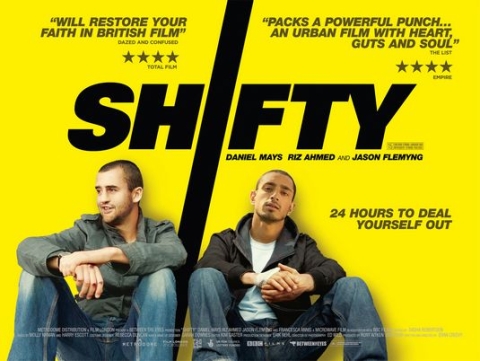
Shifty


Shifty is a film about a young british crack cocaine dealer whos life is spirailing out of control. Shifty shares in common with our short film it’s britishness and realism. This film also tackles difficult situations which are short film deals with as well.

In shifty there is a dominate bright yellow background colour that immediently grabs attention of all passerbys. The black and bold title is also dominate and signifies that this is a serious film. We may want to immitate the dominance in the use of colour in our film poster as our film shares the same level of seriousness found in this film.

Much like “sunshine cleaning” this poster features the two main actors with the written code of their names. It has the written code of the comments made by respected film review magazines and below those are the amount of stars given to them. Underneath the title is the names of the actors and below those is the slogan of the film.

Walter
I know nothing about this next film poster; I found it when I was searching for “short film poster” on Google images. This poster stood out to me not only because it is a striking film poster but because it reminded me of our film.

The poster suggests that there is one main character, Walter, who is seen in the reflection of the butcher’s knife. Our film also has one main character which the film revolves around.

The poster hints towards the plot of the film. The visuals of the butcher’s knife could suggest that Walter is a cook of some kind, or even perhaps he is a murderer and that knife is his weapon. This ambiguity leaves the audience wanting to know who Walter is.

There is the conventional use of written codes in the name of the film and the name of the featuring actors. This poster however lacks any recommendations or reasons to watch it. There are no comments made by others, there are no star ratings and there is no mention of previous work. This could be due to the fact that this is a new film and the people behind the film are all new. Alternatively it could be because this film is rubbish, but I like to stay optimistic.

Looking For Eric


As mentioned before, our film follows one lead male character. This is the same with this film “Looking for Eric”. Although there are two main characters, we are following Eric Bishop who is seen in the bottom left.

Eric Bishop’s placement was done deliberately to work with the plot of the story. With Eric Cantona being huge and light makes him look godlike whilst Eric Bishop being small and in the corner looking towards Eric Cantona shows that he is in awe of him. It works with the plot to show that Eric Bishop worships Eric Cantona.

The conventional quotes, star rating, directors’ name and writer are there. However, actor’s names are missing. This could be because Eric Cantona is already so famous that it isn’t need.

The recurring themes found in all of these posters is the written code of the actors name, the written code of the large title which normally has some sort of graphic associated with it and quotes from respected review magazines with a star rating out of five. The main image normally has something to do with the plot of the film and normally features the lead characters in that film. The colouring of all the film posters normally have one dominant colour, in “Shifty” it’s yellow and in “Looking for Eric” it is red. I will take into consideration these factors when making my film poster.

Sunday, 11 April 2010

Marketing Strategy

All films need to be marketed so that people know the film exist and people will watch it. Beneath I did some research on different screenings and different ways to advertise both contributing towards distribution.
Film Screenings
A film screening is simply when a film is shown to an audience. There are different types and stages of film screenings. Below are the different types of film screenings.

Test screening – In this stage the film may not even be completed but is shown to an audience which will give back informal feedback to the creators. A film may go through this stage many times. Test screening audiences may be told not to talk about the film.

Focus group screening – This type of screening is more formal than test screening and the audiences involuntary and voluntary responses are recorded. Audience members may be asked to answer some questions or undergo an interview for them to express their feelings about the film. The audience of a focus group screening may be asked to no talk about the film outside of the screening.

Critic screenings – This screening is for the critics of major film related businesses to see the film well in advanced of the actual release giving the critics’ time to write reviews for the movie. This type of screening is normally invitational. If the creators of a film feel as though their film will get bad reviews, they may opt to not run this screening.

Private screenings – People behind the film such as investors and film crew and even VIP media figures get to view the movie at this stage.

Preview screenings – This screen gives the public a chance to view the film. Sometimes tickets for these screenings are limited in number. Tickets may be given out as prize giveaways on radio or TV shows. The audience is allowed to discuss the film after seeing.

Sneak preview – Sneak previews are normally a couple of days before the actual launch of a film. There purpose is to help create more publicity via word-of-mouth.

After all of these screenings the film is then ready for its general release as long as a film distributor has taken interest.

Advertising Techniques

Stills and Postcards – These images of the films are used for general promotion and can appear in film festival catalogues and film reviews. For our film I will be using a postcode which will feature an iconic photo of the film along with the name of the film “Morbid Lives” and name of the main actor.

Tapes and DVDs – These copies of the film can be handed out to people at film festivals to gain attention and support. If a big film distributor likes what they see, they will be more willing to help support that film. For our film, we will be limited to two to three DVD copies.

Showreel – This edited two minute montage of your work makes it easier for other people to get to grips with your film without having to sit through the whole thing. As our film is already short, our showreel is pretty much our film.

Film Prints – This is normally a 35mm print that the cinemas use to display the film. However, some cinemas may only need a digital format to display the film. For our film, we will be limited to using on digital formats.

Press Kit – This is a full list of all relevant information about the film; such as crew members, website, synopsis etc. This press kit can be handed to industry figures so that they have all the information about the movie. We may want to go for a traditional method of simply placing all the information on an A5 sized paper to be handed to all those that attend screenings. Or perhaps we may want to go for an alternative route to show our creativity. We could possibly place all the information required on a press kit onto sets of rubber gloves.

Trailers and Clips – A small 30 second trailer is good for promotion on a website or through online social networking. Our film is short already; we may want to have a short film trailer which is limited to one or two

Websites – The website itself can be promoted to draw attention to the film. Consumers and industry figures can view the images, the trailer and the poster and read background information about the film all on the website. If needed an online screening of the film can have a password and only selected people can view it. This will help when trying to show a movie to an industry figure who is interested.

Conclusions
After doing this research I feel that either a film poster or film postcard would be a great way to promote our short film. I also feel that having a review in a magazine would do wonders for the promotion of the film. I will create my own poster/postcard and an example of a review.

Saturday, 10 April 2010

Post Production Report

Day 1 of Editing – Adding Day 1 of Filming
This is when we discovered we had broken the 180 rule and crossed the line. So we did no editing on this day.

Day 2 of Editing – Scenes 5 + 7
Now that we had reshot the road scene and had also filmed the Hall scene we logged the tape and captured what we wanted. We then started putting them all together and syncing the sound as we went.

Day 3 of Editing - Oscars
This was my chance to see what my group had done at the Oscars pizza place as I wasn’t able to attend. We added this to our editing by logging, capturing and then adding it to the timeline.

Day 4 of Editing – Lots to edit
Because our fifth day of filming consisted of filming scenes 1, 2, 8, 10, 11 we had plenty to edit. We logged and captured them all and then placed them into order into the film. We also made sure to sync the sound as we went. This took many hours.

Day 5 of Editing – IntroductionOn this day, we selected which music we wanted for the introduction and credits. We also decided on a font to use for the opening and ending credits. There were also many disputes about the name of the title as the name “Morbid Stains” was too controversial and caused arguments. We also worked on the end credits and made it look really good.

Day 6 – Voiceovers
After another day of filming we had more to edit. We edited all the scenes we had filmed and then put them in the right order on the timeline. Something which took some time was placing the voiceovers in so that they’d fit in right. This meant altercations to what we had already edited to make it fit.

Day 7 – Prepare for Rough Cut
This day was when we got feedback from others on how much we’ve already done. We had done a lot already but the feedback really helped. There was many comments on the length of the film and the pace and also issues with the scenes on the staircase. We took all these criticisms into account.

Day 8 – Finishing touches + add reshoot
Finally, we were on our last day of editing. We made the altercations that was suggested from the feedback of the rough cut and started taking out scenes which weren’t required and shortening scenes. We also added in the reshoot shots. We were then finished.

Friday, 9 April 2010

Production Report

Day 1 of Filming – Road Scene
On our first day of filming we decided to film 5, the road scene. Joe was filming, Katie was doing the sound, Daryoush was directing and I helped the actor with character movement and understanding what we wanted to see. I had to insure prior to this filming that the main actor, Geoff Shephard, was dressed correctly. Geoff had a suggestion of his own for costume design and that was the memorable green coat. In this scene he is wearing it throughout. The two scenes we filmed were of Geoff walking from one end of the road to the other end. This was a two shot scene which would have him working right to left on the screen and then coming towards the screen. We filmed during our media lesson so there wasn’t issue of too many people walking around.

Day 2 of Filming – Road scene reshootWe broke the 180 line rule and crossed the line. That means we had to reshoot this scene. With Geoff in the same clothes as before we had him walking from left to right this time and then on the second shot we made sure that we didn’t cross the line and filmed from a better angle. Everyone assumed the same roles as last time. Again, we filmed during lesson time so we didn’t have the issue of too many people walking around.

Day 3 of Filming – TC Room
Before this shooting I had arranged with our team and Mrs Shipp who was bringing in which prop that was required to create the set that I designed. The majority of the props came from Mrs Shipp and Joe Barden. We had to then set up the set as I had planned in the set design. There was an issue with finding a small table to place on the right of the scene. Instead we used one of the schools shelve unit. The pictures for the frames I found online besides one which was a picture of Mrs Shipp’s baby. Everyone put their coats up on the walls and shoes by the shoe rack. I had little to do after the set was complete and as there was limited space I just sat in the empty classroom for the reminder of filming only to reappear to help Geoff with his gloves.

Day 4 of Filming - OscarsI wasn’t available to film on this day due to a physiotherapy appointment. However, the rest of the team carried on. Katie did the sound, Joe used the camera and Daryoush directed.

Day 5 of Filming – Front Room, Staircase, Doorstep and last shotFor this day of filming I had to arrange for the props to be ready to set design the common room to look like someone’s front room. The pillows were from Mrs Shipp, the curtains from Joe and the magazines found on the coffee table from me. We filmed the two shots required for this scene as Geoff had to clean a wall and say some dialogue. The filming took less than the preparation.

Next we moved on to the location where the first and last shot was supposed to be. As Geoff learnt his lines, Joe tested different camera angles I arranged the props. I borrowed a bucket and sponge. When I filled up the bucket I had to ensure that it had warm water. Sadly, by now, Katie had to leave to go to work. We carried on and I got to take Katie’s role of sound. I had to hold the microphone in the direction of the sound and report if I heard any crackling or interference. We used some police tape that we borrowed from a friend and attached it to two cones we found nearby for the ending shot.

We then made our way to the location for the staircase shots. Because we had limited time as everyone had to go, I went up to the common room to clear up the set and pack as much as I could to save on time. Due to this I didn’t get to see what happened with filming. This was defiantly the longest day of filming.

Day 6 of Filming – Field shots, the second set of front room shots and voiceovers

We had only a limited time to film the kids as they had to leave quite early. Both came on time and were wearing the right clothes. We went outside and picked the right place to film the walking away field shot. After that we moved along to football pitch. Prior to this, I found great difficulty in finding a football and had completely forgotten all day that we needed one. Luckily Katie found a football from a staff member. To save on time, I went up to the common room to turn it back into the front room that we create on the last day of filming. By the time they had done filming outside the set was ready and we set up the camera and such. These were relatively easy to do although there was one issue with a sandwich. I had forgotten to get a sandwich ready for Geoff to eat. Instead we compromised and used a water bottle instead. Other than that, everything went fine.

To end the day we filmed Geoff’s voiceovers in a nice quite room. Meanwhile, I packed up the equipment and common room to save on time later.

Day 7 of Filming – Reshoot of the staircase scenes
The staircase scenes didn’t look that great when we edited it and we got many comments about it from our rough cut feedback. So we decided it would be best to reshoot this section. However, the deadline was coming up and many people had plans already leaving me being the only available one. I wasn’t too clear on what was required but I tried my best. It was also my first time using the camera. I aimed for 3 takes of the same thing from different angle. Geoff also didn’t bring in his costume as there was confusion with whether or not we were filming. I just tried my best to get as many different shots as possible so that when we edited it we had a lot to play with.

Thursday, 8 April 2010

Pre-Production Report

Before starting anything, planning is in order. I will look at the documents I did and move onto the documents made by the others in my group.

Production Design
Location Reccé
I had to find locations for filming that fit in with the descriptions of the settings from the script. I put information about: the best time to film; sources of power; sources of light; permission.

Set Design Inspiration Before I could create my set designs I did some research into real life locations to gain inspiration.

Set Designs
By using plan views and perspective views I have created set designs which are easy to follow and hopefully easy to replicate.

Prop List
The props are important. The props needed for the sets and who they come from are all listed.

Costume Design
Each character needs clothes to wear. I created a costume design for each character and two separate ones for Paul Bison as he features in multiple scenes wearing different clothes; work and casual.

Joe Barden - Camera
Storyboard
Joe was incharge of doing the storyboard. This is so that whole group gets an understanding of how the film will look before we start filming. Sadly, I only have one page of the storyboard.

Shot List
The shot list was written in conjunction with the script and is as equally important as it is the written form of the visuals.

Shooting Schedule
Each time we film, we must know what we’re about to film. A shooting schedule achieves this by stating which shots will be shot and when.

Katie Whitewood – Lighting & Sound
Schedule
The schedule is a written document documenting and planning what we have done and what we are going to do. This document helps with organisation. Sadly, I couldn’t get this document off Katie.

Technical Reccé
This reccé is different from the location reccé because it focuses more on moving in equipment such as lighting. By basing the organisation of the set on the set designs, equipment can be placed around the props. Sadly, I couldn’t get this document off Katie.

Daryoush Zand - Director
Call Sheet
Before filming a call sheet is required to sum up all the information about one particular day of filming. It gathers all the factors needed for that day and places them into one sheet. Also, it has a nifty weather prediction as well. There was only one call sheet made for the first day of filming.

Treatment
The treatment is a rundown of what is seen and what is heard on the screen.

Risk Assessment
Every risk must be accounted for in this document. It is sectioned for each location.

Script
The script, alongside the shot list, is the arguably the most important document. It has all the dialogue said by the characters and character movements. It’s split into scenes and is a great asset for actors.